

NYCB Vol. 13 No. 17 - Nutcracker

Updated: Jan 1, 2025

[17/52] Counting down 52 NYCB Nutcrackers this year with stories from NYCB dancers past and present! Today we hear from Dan Duell who was in the company from 1972-1987:
“I fell in love with NYCB’s Nutcracker in summer of 1968 at Saratoga Springs, when the company did a week of its Nutcracker during its then one-month annual engagement. As a new SAB student joining a special choreography project, I was privileged to see NYCB performances several times per week. Everything about it took me by storm.

“After joining NYCB in June 1972 during the historic Stravinsky Festival, a dream came true learning all the normal Nutcracker ensemble roles, then Soldier Doll, then Candy Cane, then Cavalier, with the promising young ballerina Muriel Aasen. Mr. B. rehearsed us himself, and it is that experience I treasure most about Nutcracker. The duet is a virtual lexicon of partnering skills, and Mr. B. taught us his particular intention for each and every step. And beyond the steps themselves, Mr. B. imbued us with the depth of respect and consideration he envisioned between partners, especially how the male partner anticipates and enables his ballerina without interfering with her own technical freedom. It was a demeanor, a manner of caring, that felt, and was, ennobling and up lifting. I carry that experience with me to this day in our own Nutcracker at Ballet Chicago, where I have the extraordinary privilege of passing this direct knowledge on to generations of young dancers, who perform Mr. B.’s sublime choreography for his Sugar Plum Pas de Deux each year. 2024 is no exception!”
1. Photo by Martha Swope
2. Ballet Chicago Studio Company members Ted Seymour and Rebecca Brunch
Photo by Ron McKinny
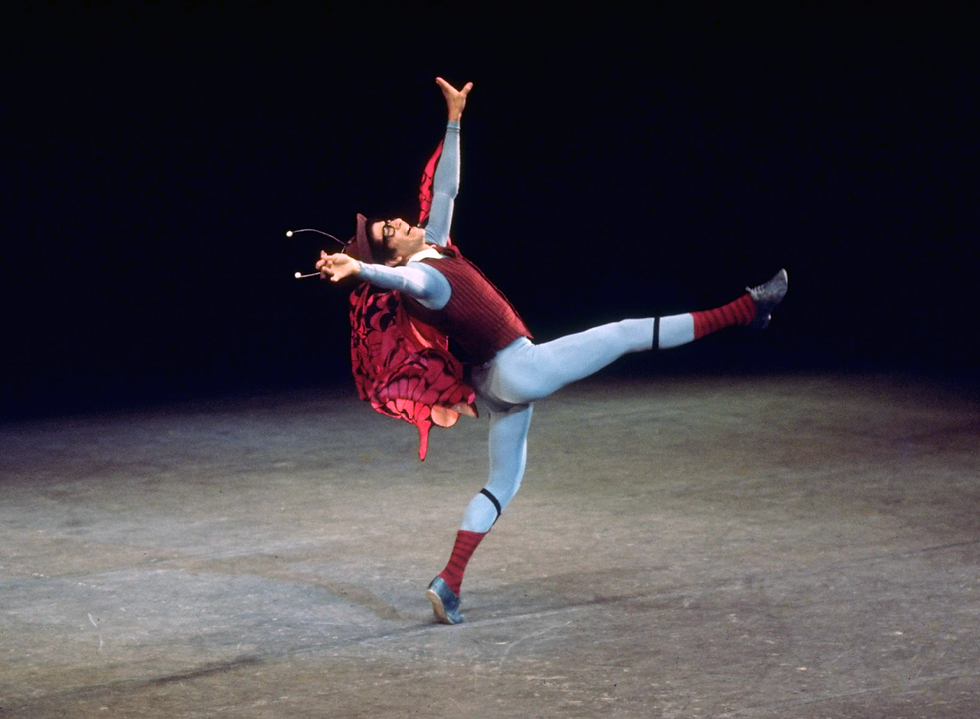
After I had learned an initial version of Candy Cane, Mr. B. coached me in an onstage private rehearsal that was a revelation and blisteringly tough education in what he envisioned for the role. I felt he wanted to revisit how he had danced it (he was particularly famed in it), and explore it afresh with me. What he taught me in that rehearsal was about extremes of twisting between hoop and body direction, with the hoop securely guided by delicate fingers. No conventional splashy split for the introductory jump. It was to be a big, sideways bending jeté. In the following diagonal sequence on stage left he asked me to do a turned-out tombé, jump into a turned-in, knees raised, flex-footed twisting leap landing in turned in first-position plié, then leap into a turned-out sissonne in attitude derrière croisé, followed by the quick cabrioles front and back, that sequence repeated three times. Then traveling to SR the chassé into the twisting gallop jump ending in developpé effacé, twice. Then the run upstage to prepare for the twelve jumps through the hoop traveling downstage--and here’s the big twist--he wanted me to jump through the hoop again with turned-in legs and flexed feet, traveling front but bringing the hoop from sideways left, not from over the top, an extra visual effect. I loved it. Also, just for fun, I had jump-roped as a child, including multiple whips between landings--it was I who introduced the double hoop jump at the end of the solo rather than Mr. B.’s original single--Mr. B. never objected, and it is now standard.
Comments