

NYCB Vol. 16 No. 4 - Ballade

The following is a chapter from Merrill Ashley's autobiography Dancing for Balanchine. In this chapter she recalls the making of the ballet Ballade

After Balanchine had recovered from heart surgery, I invited him to my apartment for dinner. He seemed in good spirits, making jokes about his health, saying he was like an old Rolls-Royce with a new engine. It was a pleasant evening, and the conversation flowed smoothly, thanks in part to Kibbe's presence. Balanchine looked so vigorous that I asked him if he was ready to return to work.
He looked at me intently and said, "Well, dear, there's music I have been listening to for a long time. I want to do something to it. I never knew just what to do. Now I know. I thought I'd do a ballet for you. Beautiful ballet."
I was embarrassed, for I felt I had forced him to state his intentions prematurely. But it soon became clear from the way he talked about the music, which was by Fauré (the Ballade for Piano and Orchestra), and the costumes and scenery, which would be from Tricolore (although slightly modified), that he had been thinking about this for a long time. It meant a great deal to me that, after being away from choreography for two years, he would choose to work with me first.
I listened to the music right away and was puzzled. It was indeed beautiful, very melodic and dreamy and perhaps a little sad, too, like some of Chopin's nocturnes, but I couldn't imagine doing anything but sitting back and letting it wash over me. What steps could Balanchine possibly find for music like that? What would the ballet look like? Beautiful? You could say that about almost every ballet that he did. The word conjured up so many different images.
Balanchine set to work immediately. I was called, along with Sean Lavery as my partner, to the first rehearsal. Many of the questions that I had had before Ballo came back to mind. Obviously this wouldn't be exactly like Ballo, but would it be another virtuoso ballet? Would I be able to do what he wanted?

Mr. B casually walked into the studio and came over to the piano where Gordon and I were talking. He joined our conversation, remarking on Fauré and the music. Then he asked Gordon to play some of the piano cadenzas in which the pianist sets the tempo. Once the tempos were agreed upon, we started to work.
Balanchine doing a new ballet was always an historic moment. I was well aware of that and yet was so involved in learning the new steps and trying to find a way to do them smoothly that I tended to block out everything that wasn't directly helpful. Later there were interviews: What was it like working with Balanchine on the new ballet? What were your impressions? What did he say? How did he act? What was he dressed like? Most of that had escaped my attention. After Ballo I found I couldn't re-create those sessions with Balanchine in all the rich detail that they deserved. I resolved it would be different with Ballade, but I was immediately involved in the concrete difficulties at hand, with all my senses attuned to Balanchine's every wish.

This time Balanchine started from the beginning. He walked toward the upstage left corner, with me following. Looking back and forth between his feet and mine as he usually did when he was thinking up combinations of steps, he said softly, "Well, maybe you come in from this corner. Just bourrée in."
As he walked on a diagonal line, he showed me how he wanted my arms to move and how I was to change the position of my body while I continued to bourrée. He hardly commented, except to say, "Well, what foot are you on?" and then he'd put himself in that position to see how to go on from there. I do remember at one point he said that I should move as quickly and lightly as a skater skimming over the ice.
Again I had the distinct feeling that Balanchine hadn't planned specific steps, but that he knew the music and its structure, the tone and shape of the work he was about to create, and the style of movements suitable for it. He knew when and where he wanted the dancers to enter and exit, and when to bring on someone else. He also knew where he wanted the high points to be. Just as when he was choreographing Ballo, I was struck by the speed and spontaneity with which he worked. He always seemed to be improvising.
Balanchine was not nearly so hardy as he had been when he had done Ballo. This time he didn't partner me unless things were really going wrong or he couldn't verbally explain what he wanted. When he did partner me, I tried not to make him support my full weight, but that always made him a little angry. "No, it's all right; it's okay," he would say. But I was always fearful both of the strain on his heart and also of the possible harm to his vulnerable back and knees. When he gave us steps in our variations, he would explain them with words and hand gestures, or by marking the steps with his feet. Rarely did he do steps full out, the way he had done in the past.

One sequence that Balanchine choreographed very quickly but that subsequently required constant work occurred in the pas de deux in the second section of the ballet.
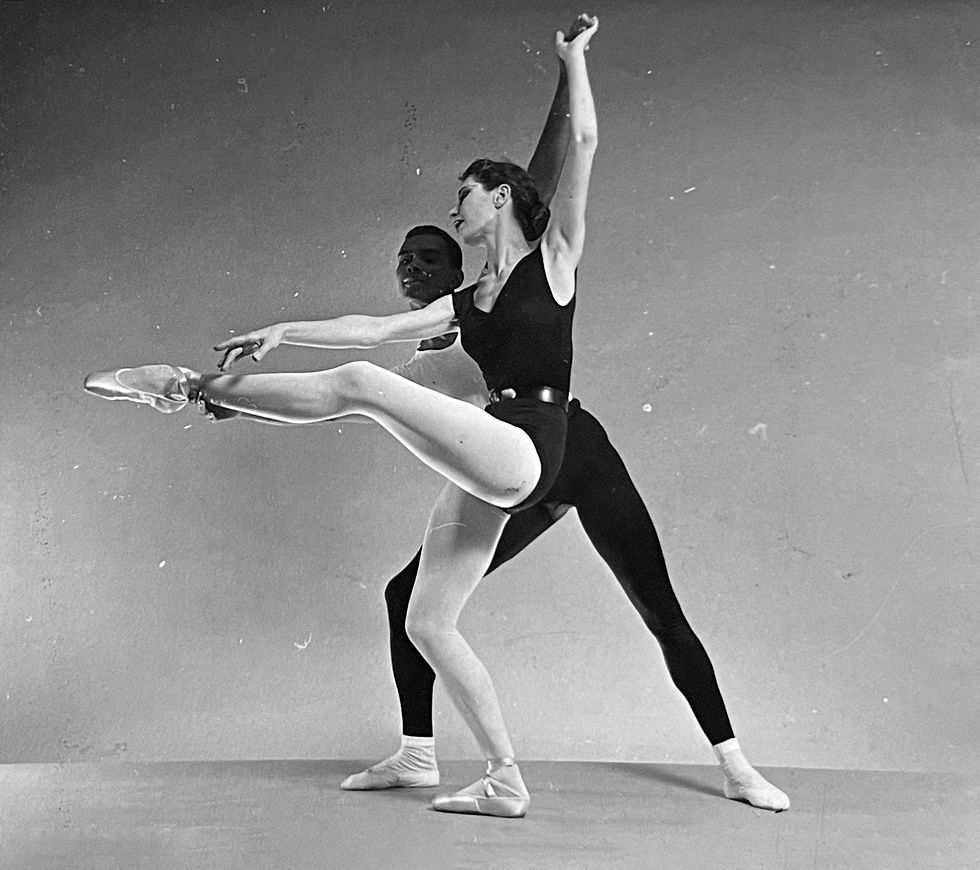
He asked me to step onto pointe with my back to the audience while holding my partner's hand, and then do a side développé with my left leg. Once I had reached the full extension of the développé, he wanted me to lean backward, still holding my leg up, which caused me to turn backward off balance. It looked as if I were out of control and about to fall. He wanted me to control this fall so that it did not happen too quickly, but he also wanted the fall to look spontaneous. The minute he thought the fall was becoming too controlled, he said, "No, you're not falling enough."
While choreographing Ballo, Balanchine had asked me which leg was easier to lift to the side, and then he had adapted the choreography to that leg. But, in doing Ballade he never asked me this question, and so I had to do the side développé with my "bad" left leg. It is just not as "educated" as the right, not as turned out, and not as comfortable to work with, which made the step even harder to perform. This is one of the few recurring steps in the ballet; it is the only one that is repeated at different points, and I worked on it constantly. At the very end of the ballet, Mr. B wanted the sequence repeated very slowly, saying to me, "Fall in slow motion." I tried doing it as slowly as I could, but I could not find a way to conquer gravity!
In my second variation in Ballade, there is a combination related to my unusual turning step in Ballo's second variation. In Ballade, Balanchine gave me this tricky combination very simply, saying only, "You chaîné [fast traveling turns on pointe] and when you're ready, without coming off pointe [that's the hard part!], do an en dedans pirouette opening into arabesque on pointe, and then repeat it until the music changes." (In this case the en dedans pirouette was a turn to the right on my right leg, with my left leg shooting out from passé into arabesque.)
We were using a rehearsal studio at SAB that day, and the room was crowded with students, teachers, and Company members. Everyone was there to watch Balanchine work on his first new ballet in two years. When we heard what he had asked for, we all burst out laughing because it sounded utterly impossible. I thought he was going to see that I was not as strong as he believed. But I was prepared to give it everything I had to make it work.

I went into a corner, started the turns, and did the series of steps exactly the way he had asked. There were gasps of awe as I finished my first attempt at these turns. I was more stupefied than anyone. I asked to do it again, and once more it went perfectly. Bal-anchine's eyes twinkled as if to say, "You see, I told you so!" Despite my elation, I had some misgivings. I knew this difficult sequence was in the ballet to stay. Was this just an "on" day or was the step easier than I thought?
The next day, I couldn't do the sequence at all. I had already spoiled it by thinking too much. I kept losing my balance in the middle of the turn as I began to open into arabesque. It took me three weeks before I was able to recapture what I had done that first day. Whenever the step went off, it was really off, like the turning variation in Who Cares? There was no covering up. Unlike my experience in Who Cares?, however, I found that rehearsing this step made it go better. Here, as was so often the case with difficult steps, the right use of the arms made all the difference.
There was a break in the creation of Ballade between the winter and spring seasons. When we resumed work on the ballet, Ib Andersen replaced Sean, who was still recovering from knee surgery. For a while Sean took part in the rehearsals as best he could, hoping to be ready in time for the premiere, but finally, with a week to go, he realized he wouldn't make it.
As we began work on the second part of the ballet, we found that we had forgotten little bits of choreography that had been set a month or so earlier. Balanchine had little difficulty rechoreographing these steps, but he had other more serious problems. He could not get the corps girls to do what he wanted. At one point he stopped and said: "You know, I can't do what I want to do, because I have to stop and teach you how to dance."
Each time he gave them a new step, he would spend several minutes trying to get the girls to place their feet properly, move on the exact count he had given them, start and stop each movement with energy and clarity, or move in the exact pattern he had shown. One time, in particular, when his patience was at an end, he threw up his hands, letting them fall with a slap against his thighs.
"I had good, interesting idea, but you can't do it," he said. "I'm not sure if you'll ever be able to do it. Now I have to think of something else."
Balanchine was using apprentices who had been called to the rehearsal as under-studies. The regular corps girls had missed the first hour of rehearsal because of a conflict in their schedules. Balanchine decided that, since he had started using the apprentices in rehearsals, he might as well put them in the ballet. (Apprentices may dance any number of times in two ballets per season.) Balanchine was not inclined to show the apprentices any special lenience, although he did try to be more patient with them. If anything, he was more strict with them because he knew they were not familiar with the way he wanted things done. He could not just give them a brief reminder, as he could the Company members; he constantly had to correct them.
There was nothing unusual about Balanchine's having to use corps girls who were not of his choice; this was especially true during festivals. He would generously allow other choreographers to use the dancers they preferred, and then he would work with whoever was still available. Although he often had to do so in a small practice room without the pianist of his choice and at hours he did not like, he still produced great choreography.

Balanchine also had to help teach Ib what was for him a new type of partnering. But Ib was eager to learn and adjusted quickly. For a long time, Ib didn't know the first part of the ballet, so I rehearsed half the ballet with Sean and the other half with Ib. Little by little, as each learned the sections he didn't know, I found myself rehearsing Ballade with two very different partners. Everything from the phrasing to the mechanics of the steps, not to mention the mood, differed with each. Although this disparity gave me more ideas about possible approaches to the ballet, it also meant I couldn't become really familiar with one way of dancing it, which left me in a state of confusion until a week before the premiere, when it was decided Ib would do the first performance.
Both Sean and Ib were experienced partners, which was a great luxury. Early in my career I had danced with inexperienced partners, some of whom were not tall enough for me and most of whom seemed less interested in partnering than in their own variations. I rarely saw any of them, or the other men, watching from the wings when Peter Martins, Adam Lüders, or Sean were doing their fine partnering, but the wings were suddenly full during their spectacular solo variations.
Dancing with these inexperienced partners had had both good and bad effects on me. It had made me more aware of the technique of partnering (I often had to tell them what to do), but it had also made me want to do too much by myself. It took me a long time to unlearn some of the "survival" techniques I developed during this period.
As Ib and I rehearsed Ballade, Balanchine never talked about the mood of the ballet, who we were supposed to be, or what we meant to each other; he simply stressed the steps and patterns. The rest was up to us.
Interesting clues about the ballet as a whole could be found in Balanchine's gestures and in his demeanor as he showed us what he wanted. There were clues, too, about Balanchine's attitude toward women in general, and perhaps toward me in particular. After all, there were many moments in his ballets that seemed to be enactments of his most ardent thoughts and feelings, and an expression of his special kind of love for women. I felt this at one point early in the ballet. As I leaned back slightly with my arms wide apart, Balanchine, showing Sean what to do, placed his head tenderly on my chest, almost as if he were listening to my heart. It is only a fleeting moment in the ballet, one that a spectator could easily miss, but it spoke eloquently to me of Balanchine's emotions during the period he was choreographing Ballade. That moment is followed by a series of steps that suggest we are being pulled part, then drawn together, and then torn apart again. Finally, I do a series of chaînés that end with my falling forward toward my partner, who catches me under the arms. With my back arched, I look up at him in supplication. Again, it is only a brief moment before we are pulled apart by forces greater than ourselves. Time and again this theme repeats itself in Ballade, and, as I practiced these steps in rehearsal with Balanchine watching, I often saw in them a reflection of forces that had acted on the two of us. I wondered if he saw that, too.
The first comments from Balanchine that gave me any hint of how to interpret the ballet came while he was choreographing the final moments of the ballet. Ib and I were very close to each other, face to face, clasping each other's hands, about to be separated by that unknown force.
"Don't look at him. You're not in love with him."
Balanchine, once again, had made it clear what he did not want. But, what, exactly, was he after? If he did not want me to look at Ib, where did he want me to look, and with what kind of expression? If I wasn't in love with my partner, how did I feel about him? The answers to these questions were left up to me, as usual. I felt I couldn't ask for help on such matters; he didn't want us concocting fantasies to help us through ballets. If I had asked him, I am sure he would have replied: "Don't think, dear, just dance!"
Fortunately, I wasn't in the habit of creating specific fantasies to guide me through ballets. But I did at times want to understand my relationship with my partner-for example, during the closing moments of Ballade. To me, that final parting was sweet but sorrowful. Perhaps Balanchine had felt I was being "too sweet" again. I decided a little more distance, a certain elusiveness, was needed.
In many of Balanchine's ballets there is a woman who is distant and elusive. Her partner, whom Balanchine might have seen as an image of himself, is never allowed too close, although he is an ardent lover. That kind of woman is not in my nature, which is warm and more direct, but she is a type I understand, and I am certainly able to play that role. Such a woman, if only because of the ambiguity in the ballet between what is real and what is imagined, has a place in Ballade.
In a further effort to understand my role in Ballade, I tried to imagine the impact of the ballet as a whole. It would have helped if I could have seen the ballet performed, no matter how well or badly it was done. Then I could have decided more objectively what worked and what did not. In Ballo I had instinctively felt my approach was right, but here I sensed something was amiss. I felt I had not yet reached the heart of the ballet, and I was sure I would have to perform it many times before arriving at a clear idea of what I wanted to do with it.
Ballade's gently changing moods appealed to the romantic side of my nature. Balanchine's comment that I wasn't in love didn't change that. The opening of the ballet was wistful, suggesting neither dream nor reality but something in between. My partner appears, disappears, and reappears, our fleeting encounters seeming to suggest both strong desires and vague yearnings. I then have a brief solo that sustains this feeling of ambiguity. Later I dance with the corps girls and am clearly in a more positive mood, letting my spirit and energy dictate the steps and my sweeping
My partner then renters and we come together but are once again drawn apart, over and over. At the end, we face each other, clasping hands, and then withdraw in an exact reversal of our first entrance, each returning to his own private world
Throughout the ballet I seem to be in perpetual motion, an elusive, unattainable figure. My presence is strongly asserted by the uninterrupted succession of difficult steps, flowing arm gestures, and expressive movements of the torso. Yet the music, steps, and gestures tell me that it is a romantic presence. The ballet is not about steps, but it is a virtuoso ballet in every sense-not the bright happy virtuosity of Ballo but something that could be called romantic virtuosity, if that is not a contradiction in terms.

When Balanchine had finished choreographing my solo with the corps girls, a little more than halfway through the ballet, I realized that in performance I would reach that point having had only a few moments of rest offstage. What a phenomenal endurance test! Balanchine was not only challenging me to use my upper body in a new and more expressive way; he was testing my endurance, unwittingly, I am sure. He did not seem to realize the cumulative effect of all these steps and sweeping gestures. Even a respite of a half minute would have made all the difference. I was determined, however, not to complain. If he felt there was something I could not do, if he found me losing my fluidity and ease due to fatigue, perhaps he would make a change.
As we worked on the last part of the ballet, my left hip began to hurt. At first, it felt like a bruise I might have gotten from bumping into a doorknob, and I didn't pay much attention to it. Besides, it hurt only when I was in fifth position, not when I lifted my leg. I was sure that, like so many other aches and pains, it would disappear as mysteriously as it had come.
There were constant rehearsals of Ballade, and in addition I was dancing even more than before: every morning, I took class; every afternoon, I rehearsed for four or five hours; and, every evening, I performed, sometimes in two ballets. On a number of occa-sions, I did two of my most demanding ballets either Ballo and Piano Concerto or Square Dance and Theme on the same program. Although I savored every moment on stage, it was simply too heavy a workload to carry safely week after week.

I underestimated the toll all this was taking. Somehow I hadn't yet realized that I had reached the point of diminishing returns. Balanchine had always said, "More, more!" and I had perhaps taken those words too literally. In my eagerness to overcome all obstacles, I had always found the energy that Balanchine asked for; but now as I worked increasingly on more subtle aspects of my dancing, it became clear that I had not entirely rid myself of the tendency to dance every performance as if it were my last. It was much more exciting for me to dance that way, and I was reluctant to give up a single moment of pleasure. My dancing had finally reached a level that allowed me to revel in the mastery of my body and the steps. It was enormously satisfying and enjoyable to be on stage, feeling confident and at ease and able to bring something of my true self to my performances. But Ballade and my hip were soon to teach me a few new lessons.
Ballade was proving to be the greatest physical challenge in my repertory, to speak only of one aspect of the ballet, and I would soon learn that I had to temper my effort if I was to survive. As yet, I had no feeling for where the high points in the ballet were and where I could "rest" a little, but I did sense I was making it harder than necessary.
The pain in my hip began to bother me more and more, and I realized it was no mere bruise. On the day of the premiere, May 8, 1980, it was worse than ever before. For the first time, the hip hurt too much to allow me to walk normally. As I walked the few blocks downtown from my apartment to the theater that morning, I wondered how much I would aggravate my hip during orchestra and dress rehearsals that afternoon. There was no question of my not dancing the world premiere of a ballet Balanchine had done for me, but I didn't want to be distracted by intense pain.
Despite my handicap, the performance went surprisingly well. All the usual trouble spots turned out to be trouble-free. It's impossible to explain why such things happen, but I'm inclined to think that pure chance plays a certain role. The most memorable part of the evening was the struggle I had to get Balanchine to take a bow. I had anticipated the problem and was prepared. Balanchine never wanted to take credit just for himself; in general he went in front of the curtain to acknowledge applause only when it was intended as a tribute to the Company as a whole, as at the end of the season. Both the stage manager and I tried to coax him into going in front of the curtain, but he refused. Finally I took him by the arm and said: "Mr. B, please, do it for me."
"Only if you go with me, dear."
"Don't worry. Ib and I will both go with you."
And with that I took his hand and led him in front of the curtain, where he was cheered by an adoring audience.
Photo by Martha Swope
People's reactions and the reviews about the ballet fascinated me, giving me the first objective impression of what I had just done. Everyone seemed to have a slightly different interpretation of the ballet, but the word most frequently heard to describe it was beautiful. I had thought-if only because the word could be used to describe almost any Balanchine ballet—that it would be the least likely word to be heard on everyone's lips.
But, after watching the ballet, everyone invested the word with such meaning and pronounced it with such conviction, that no other adjective seemed to describe the ballet quite so accurately. I was even reminded of the way Balanchine had spoken that word when he first mentioned the ballet to me. It was uncanny. He had found a way to merge nonstop dancing and difficult steps with the music so as to project a single overpowering impression of beauty- beauty that transcended the subject, beauty that made differing interpretations of the ballet equally valid.


Comments