

NYCB Vol. 18 No. 3 - Agon, Edward Villella


From Edward Villella's autobiography Prodigal Son: Dancing for Balanchine in a World of Pain and Magic
"One day Balanchine stopped me and matter-of-factly told me that I was going to be the understudy for Todd Bolender in Agon. I thought this was terrible news. Agon was probably the single most complicated work in the history of classical dance up to then. I was still trying to adjust to the sounds of the music. It was the first time I had been exposed to such a stark neoclassic style, an almost total abstraction of classical technique. Even an experienced dancer would have had his problems trying to follow Agon; for me it was a nightmare. Having been away for four years, I didn't know about the developments Balanchine had been making in the art, and I was completely out of my depth.

"I didn't really have the confidence then to perform the remarkable gestures the ballet called for, gestures that I had not only never done but had never seen before. The first time I performed them they felt unnatural, and I was as uncomfortable with them as I was later on in my career when I had to do mime. But Balanchine said, 'Ballet dancers make the unnatural natural,' and I kept on working until these movements came more easily. One factor worked in my favor, almost subconsciously. Agon was a wholly American work, a representation of the new classicism, and as an American the style of the movements readily, almost instinctively, suited me. [...]

"In the long run, however, it was satisfying to have been present at the creation of Agon. I was dazzled by it all, by the way our attention was intensely focused on Balanchine in the studio. Everyone waited, still and quiet, while he pondered a problem staring blankly at his index finger. Suddenly he'd come to, clap his hands, and say, 'Okay,' and he'd start working again."
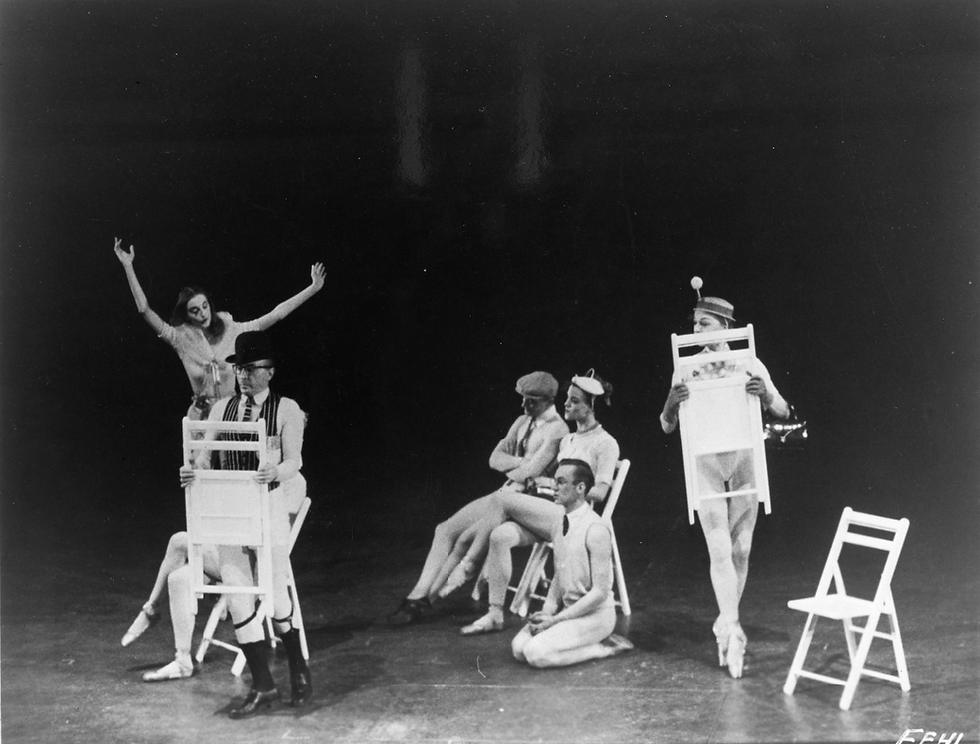
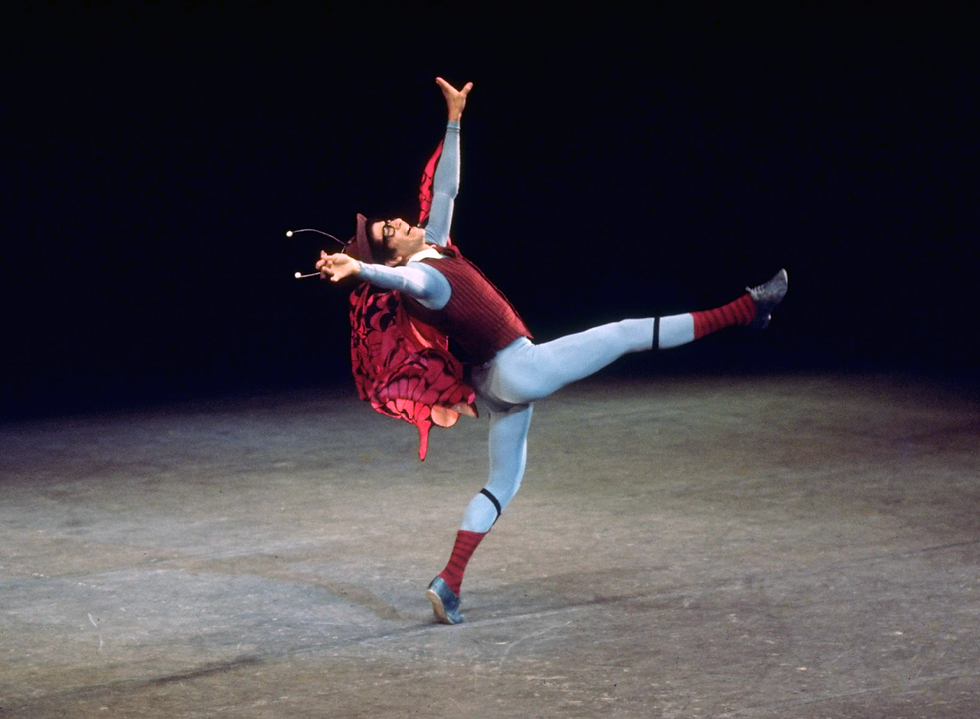
(left) Diana Adams, Melissa Hayden, Arthur Mitchell, Edward Villella, Patricia Neary 1963
(left center) Carol Sumner, Richard Rapp, Diana Adams, Arthur Mitchell, Patricia Neary, Edward Villella 1964
(right center) Carol Sumner, Edward Villella, Patricia Neary, 1964
(right) Edward Villella, 1964
Photos by Martha Swope.
"One day when Balanchine was choreographing, the session was unexpectedly interrupted by a visit from a man whom everyone treated as royalty. In each of the huge studios at the school, a door opened onto a platform, and a staircase descended into the room. On this particular afternoon, everyone in the studio was intent on the ballet—the rehearsal was generating a great deal of energy and vitality, and no one paid any attention to who was coming in or out. All at once, activity came to a standstill. The door had opened, and everyone's eyes turned to an unusual-looking figure who was standing on the platform. I felt a change in the air, but didn't realize what was going on. What was happening? I wondered. I stopped what I was doing and looked up.

"The tiny little man at the top of the stairs was wearing a huge camel's-hair coat that fell well below his knees and practically hid even his hands. Only a joint or two of his fingers, covered in gray suede gloves, pecked out from the sleeves. On his head was a homburg that came down over his forehead to his eyebrows. I noticed glasses and a mustache, and that he was carrying a cane. He didn't move a muscle, but the entire room paid reverence.
"The rehearsal pianist, Kopakeine, was the first to rush up. Then Balanchine climbed the stairs, and together they escorted the visitor down the staircase into the studio. I could see that he commanded the greatest respect. Everyone hovered around him.
"'Who is that?' I asked the dancer alongside me. 'It's Igor Stravinsky,' she whispered. The famous composer, of course, who had written the score for the ballet.
"Inside the room, Stravinsky moved to a chair, took off his hat, and handed it to his companion. Then he put his cane aside and removed his muffler, his coat, and finally his jacket. This tiny man grew even smaller as he shed his outer garments one by one. But once he got down to his shirtsleeves, he looked enormous. It was incredible: he assumed the proportions of a giant.
Balanchine, Stravinsky, Kopakiene. Photos by Martha Swope, 1957.
"Stravinsky and Balanchine pored over the score together. They stood around the piano, talking in Russian and English. Sparks were flying. We all felt exhilarated in the presence of these two witty geniuses. They seemed to fill the space in the studio. Energy had doubled since Stravinsky's arrival, and now everything in the room was orbiting slowly around the startling vitality Stravinsky and Balanchine were generating.
In a few moments, Balanchine went to work again with the dancers. Occasionally, he'd stop and turn to the composer, and the two of them would savor the moment. What a thrill to see them collaborate. The pleasure they took in the work, their compatibility, not only as Russians and colleagues but as artists, was palpable. We even shared in their laughter. After a step or a gesture had been done to their satisfaction, they would stop the pianist and beam—they were so pleased with what they had created. It was remarkable to have the composer on hand, but of course the civilized atmosphere in which the work was being done was typical of the way Balanchine worked. Stravinsky was so relaxed he even conducted a little. He was so polite, so gracious, that it might have been patronizing if it hadn't been clear that he was absolutely sincere.
"On that afternoon we were all aware—at least I know I was—of the significance of what was happening. It isn't often a person can say that he is witnessing an event that's going to change a country, a world, an art form, whatever. But we all felt that Agon was a ballet that was going to alter ballet history. And it did. I have never, ever, heard such screams and shouts of approval in a theater before or after. It was truly unbelievable."

Comments