

NYCB Vol. 19 No. 13 - The Unanswered Question


From Allegra Kent's autobiography Once A Dancer:
"'Did you hear that?' Mr. B. imitated a trumpet and repeated a voice we just heard in the piano score.
I nodded my head. 'Allegra, when that starts, open your arms slowly and start to sit.' Now the men received their instructions. 'Make a chair for her with your hands.' Mr. B. continued to surprise us.
"I was to be like an elastic icon, ever unattainable, standing on the shoulders of two of the men who were to be my floor. The two others braced me while Todd, arms outstretched, was in front of me walking backward. That is how the dance began. The four men were my spaceship, constantly manipulating me in a slow rhythm around and above their bodies, through their legs, lifting, turning, supporting, sometimes pulling me around as though they were hauling rope. Mr. B. never explained the story, only how to work out his ideas mechanically to achieve the effect he wanted.
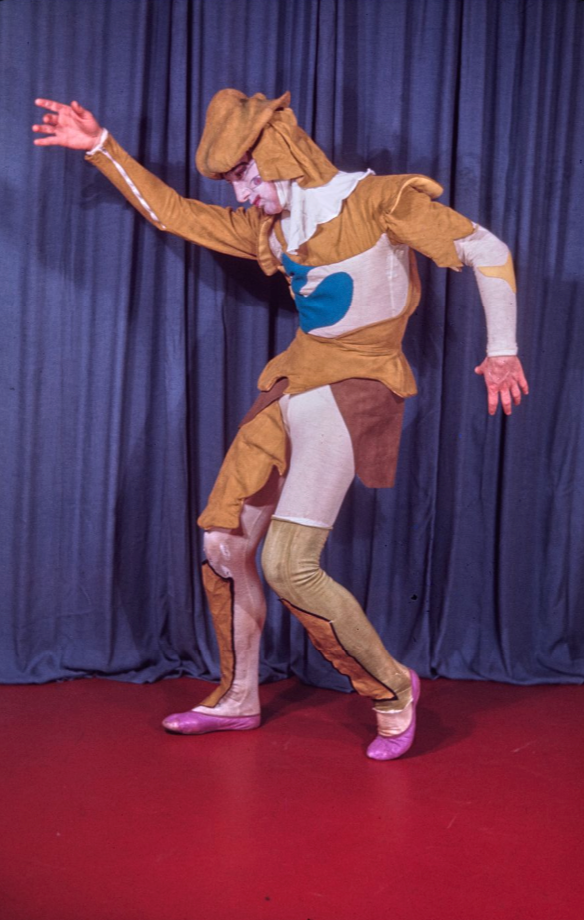
Photos by Radford Bascome, 1954.
"'Now hold her up above your heads,' he instructed. As I curved myself into a small shape like a lima bean, he directed four pairs of arms to hold me aloft. From this seed position, I was to extend one leg downward and, as my body uncurled, stretch the other leg into an arabesque. He told the men that they could talk quietly among themselves-even during the performance—to coordinate their effort. 'So everyone will be ready to move simultaneously.' In this way, beginnings and endings became seamless and transitions liquid.
While I was standing high on the shoulders of two of the men, Mr. B. told me, 'I want you to lean backward very slowly until you fall. Don't do it yet.' He walked in back of me to instruct the other two men on how to catch me. 'Okay, Allegra, let's try it.'
My backward fall, which started almost imperceptibly, gained momentum until my body disappeared from sight. This was so startling that I later heard gasps of terror from the audience during perform-ances. I trusted my men, but nevertheless in that first rehearsal I had to look back to make sure that they were ready. Mr. B. was there also to make sure of my safety.

By the end of the first day, I loved this moment when I fell over backward from a great height, slowly inching my way into a grand swoon and toppling over. It's fun to fall if you know you'll be caught.
Singing the trumpet part again, Mr. B. told us what musical clues to listen for along the way. This dance was like a hike in the mountains. A certain sound was a big white boulder or a tree bridge over a stream.
This role was not technically difficult. "The Unanswered Question" had more to do with creating an atmosphere than with dance technique. My costume was simple: a white leotard and nothing else— no tights, no shoes, not even hairpins— bare legs, bare feet, long hair. A bare body with a white costume. The color white was symbolic in a Balanchine ballet. This piece was the latest version of his constant recasting of the enigmatic "girl in white." The spiritual. The otherworldly. Not only was the bareness of the costume related more to theater than ballet, so was the choreography.
"Unlike what happened in classical partnering, where contact was mainly on the waist and arms and involved lifts and sustained moments on pointe, in this ballet I was definitely 'manhandled' by my four supporters. (Brooks Jackson, one of the men, asked me at the second day's rehearsal if my body was sore, and when I said no, wondering why he asked, he said, 'Ah, la jeunesse.') In this role I was manipulated — threaded under legs and pulled into splits— all the time remaining passive and inaccessible. The woman in this ballet ultimately represents the unattainable. She attracts and eludes the man who tries to grasp her. The mystery is never solved, the question never answered.
"Arlene Croce said of me in this role, 'Allegra Kent does not seem to belong to herself, yet she doesn't belong to her manipulators either—they're her mystery.'"


Comments